



A dead car battery has a way of showing up at the worst possible moment, but the good news is that it rarely goes out without warning. Luckily, we've got everything you need to know about car battery lifespan, the tell-tale signs your battery is on its way out, and what to do when it's time for a replacement.
How long does a car battery last in Singapore?
If you drive in a temperate country, you'd typically get three to five years out of a standard car battery. However, Singapore’s tropical heat is tough on batteries. The high ambient temperatures accelerate the chemical reactions inside the battery, causing it to degrade faster than it would in a cooler climate. Add in our year-round air conditioning use and frequent short trips around the heartlands, which don't give the battery enough time to fully recharge, and it's easy to see why car batteries here tend to die young.
In practice, most drivers in Singapore find that their battery lasts anywhere from 1.5 to 3 years, depending on driving habits, vehicle type, and how well the battery is maintained. As a general rule of thumb, once your battery hits the one-year mark, it's worth getting it checked during your regular servicing (you are getting your car regularly serviced, right? 🥺). If it's heading towards three years, consider replacing it proactively rather than waiting for it to fail on you on the PIE.
Signs your car battery needs replacing
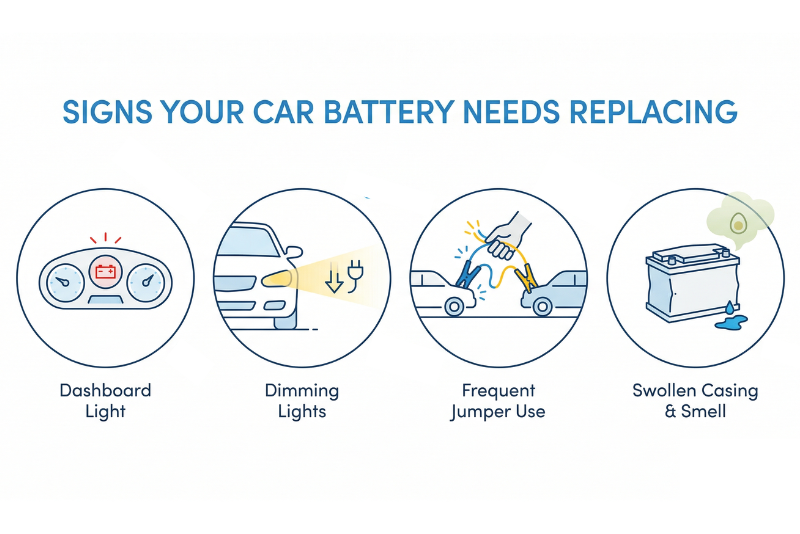
Thankfully, a dead car battery is easy to pre-empt if you know what to look out for:
1. Slow or sluggish engine crank
This is one of the earliest and most common signs. If your engine sounds laboured when starting up, your battery may not be supplying enough power to the starter motor. Don't brush this off as a one-off; if it happens consistently, get your battery checked promptly.
2. Dashboard warning light
Most modern cars have a battery-shaped warning light on the dashboard. If it lights up, it's a clear signal that something in your battery or charging system needs attention. It could point to the battery itself or a faulty alternator, so it's best to head to a workshop to get a proper diagnosis.
3. Dimming headlights and electrical issues
A weakening battery struggles to power all of your car's electrical systems simultaneously. Noticeably dimmer headlights, sluggish power windows, a radio that seems quieter than usual, or erratic dashboard lights are all signs that your battery may be losing its capacity. Think of it like trying to run too many apps on a phone with a nearly drained battery: everything starts slowing down.
4. Frequent jump-starts needed
Needing a jump-start once in a while isn't necessarily cause for alarm; it could simply be a case of accidentally leaving the lights on. But if you find yourself needing a jump-start more than once in a short period, that's a strong indicator that your battery can no longer hold a sufficient charge and needs replacing. Repeated jump-starting also puts strain on the alternator, which can lead to more expensive repairs down the line.
5. Swollen or bloated battery casing
If you pop the hood and notice that your battery casing looks misshapen, swollen, or bloated, get it seen to immediately. This is typically caused by excessive heat or overcharging, and it means the battery is at risk of leaking or even failing suddenly.
6. A rotten egg smell near the engine
A sulphuric or rotten egg odour coming from under the hood is a sign of a leaking battery. Battery acid leaks can corrode surrounding engine components, so if you notice this smell, get to a workshop as soon as possible.
7. Your battery is over 2 years old (in Singapore)
Given our climate, if your battery is approaching or past the two-year mark, it's wise to have it tested even if it appears to be functioning fine. A load test at a service centre can tell you exactly how much capacity your battery has left, so you can plan a replacement before you're caught off guard. A healthy battery at rest should read at least 12.6 volts, while consistently lower readings suggest it's time for a change.
What to consider when choosing a replacement battery
When it comes to picking a new battery, a few key factors are worth keeping in mind:
- Compatibility: Make sure the replacement battery is the right fit for your car's make and model, both in terms of physical size and technical specifications
- Amp-Hour (Ah) rating: This measures how much energy the battery can store. If you run accessories like dashcams or a sound system, a higher Ah rating gives you more reserve power
- Cold Cranking Amps (CCA): This indicates the battery's starting power. Even though Singapore doesn't get cold, a higher CCA rating is still beneficial for larger engines or vehicles with higher electrical demands
- Heat resistance: Look for batteries designed for tropical climates, as they're better equipped to handle Singapore's conditions
- Brand reputation and warranty: Well-regarded brands like Bosch, Amaron, Varta, and Delkor are popular choices among Singapore drivers. Most quality batteries come with at least a one-year warranty
Workshop vs. mobile replacement service
Once you've decided it's time for a new battery, you have two main options: heading to a workshop or calling a mobile replacement service.
A workshop visit is ideal if your car can still be driven. Workshops typically have better diagnostic tools, so they can run a more thorough check on your charging system to ensure the problem is solely battery-related and not an alternator issue. If you're due for regular servicing, it makes sense to bundle the battery replacement in at the same time.
A mobile replacement service is convenient if your battery has already died and your car won't start. Many providers in Singapore offer 24/7 islandwide services and can arrive within 30 to 60 minutes. They'll replace the battery on-site and often include a diagnostic test as part of the service.
Typical battery replacement costs in Singapore range from around $100 to $300, inclusive of the battery, installation, and a warranty. The exact price depends on your car model and the battery brand you choose.
Tips to extend your battery's lifespan
Getting a few extra months out of your battery comes down to a few simple habits:
- Go for longer drives occasionally. Short trips don't give the battery enough time to fully recharge. Fitting in a longer drive every now and then helps keep the battery in good shape.
- Switch off electronics when the engine is off. Leaving the lights, the radio, or other accessories running with the engine off drains the battery unnecessarily.
- Keep the terminals clean. The humidity in Singapore can cause corrosion to build up around battery terminals. Check them every six months and clean off any white or ashy buildup to maintain a good connection.
- Park in the shade or a covered lot where possible. Minimising prolonged sun exposure helps reduce the heat stress on your battery.
- Get your battery tested during regular servicing. Catching a weakening battery early is always better than being stranded with a flat one.
Staying on top of your car battery's health is one of those small habits that saves you a lot of hassle in the long run. If you'd like to skip the maintenance headaches altogether, GetGo's fleet is always serviced and ready to go. But if you’re still driving your own cars on the road, be sure to check out our guide to the 3 different types of car insurance in Singapore for more handy tips on protecting yourself on the road.
See you on the road,
Amanda 💙
(Feature photo from: AutoNation Mobile Service)


