




(Last updated: 6 October2026)
If your last few trips to the petrol station have left you staring at the pump in disbelief, you're not imagining things. Petrol prices in Singapore have surged to record highs in early 2026, leaving drivers like you and me scrambling to make sense of it all. Will gas prices keep rising? When will they get back to normal? Is this just my life now?
So let's break it down together. Below is everything you need to know what’s up with petrol prices in Singapore, why they've climbed so steeply, and (most importantly) how to ease the pinch on your wallet.
What petrol prices look like right now
As of 6 October 2026, here's how prices stack up across Singapore's major petrol stations (in SGD per litre, before any discounts):
If you're on RON 95 or Ron 98, Cnergy is your cheapest option at $2.69, with Shell close behind. And if you drive a diesel vehicle, you'll notice something unusual: diesel is now more expensive than petrol almost across the board, which is a first for Singapore.
Thinking about downgrading your petrol to save a few bucks? Be sure to read up on our guide to choosing the right petrol to see if it’s safe to do so.
How to pay less at the pump
The good news is that with the right combination of credit cards and loyalty programmes, you can knock a significant chunk off your effective petrol price, even at current highs. The best combinations can bring your effective RON 95 cost down to around SGD$2.66–$2.71 per litre, saving over 20%.
Here's a quick breakdown of the top pairings:
- Caltex/Esso/Sinopec + OCBC 365 Card: Up to 29.5% off, bringing RON 95 to approximately $2.66/litre — the deepest discount available right now
- Esso + DBS Esso Card: Up to 26.2% off, effective RON 95 around $2.68/litre
- Shell + UOB One Card + Shell GO+: Up to 21.15% off with the free Shell GO+ loyalty programme stacked on top
- SPC + POSB Everyday or UOB One: Up to 20.1% off, effective RON 95 around $2.68/litre
If you prefer to skip the card game altogether, Smart Energy stations (at Mandai and Jalan Buroh) offer some of the lowest net RON 95 prices in Singapore at around $2.48/litre for members through a prepaid top-up system.
Why are petrol prices so high?
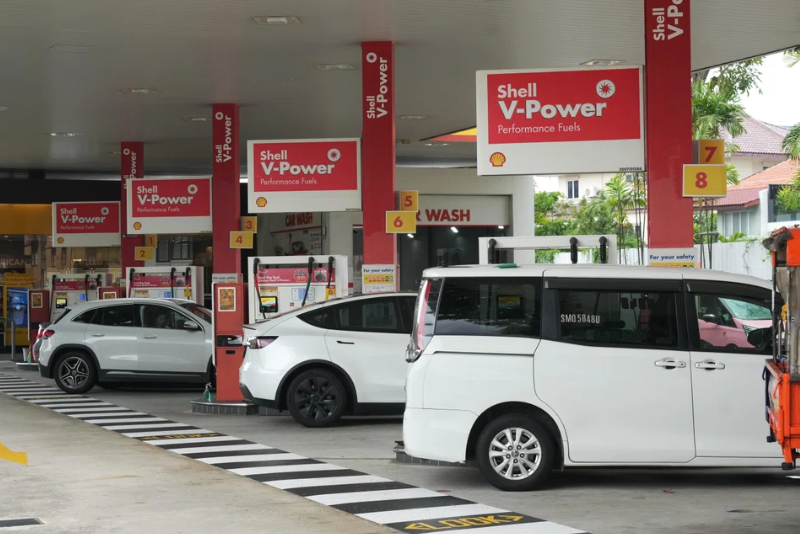
Ongoing conflict between America and the Middle East has disrupted the flow of oil globally, and Singapore (which sources over 70% of its crude oil from that region) is feeling the impact directly.
The Strait of Hormuz, a critical waterway that carries roughly one-fifth of the world's daily oil supply, has seen severely reduced tanker traffic since early March. That's led to a sharp drop in global oil supply, sending crude prices surging. Brent crude, the global benchmark, hit a peak of around $119.50 per barrel in mid-March, compared to around $65–$73 before the conflict escalated.
Here in Singapore, pump prices reflect global crude costs almost in real time, as retailers set prices based on the Mean of Platts Singapore (MOPS) — the regional benchmark for refined oil products. The government doesn't cap or subsidise petrol prices, so when crude costs spike, pump prices follow. By mid-March, RON 95 prices had already surpassed the previous record of $3.42 set during the Ukraine crisis in June 2022.
Will petrol prices keep rising?
Prices have now gone up twice in three weeks. The first round came on 14 September, after roughly two months of steady prices. The second rolled through between 29 September and 2 October, when all five majors added about five cents a litre to petrol.
What gives? Brent crude pushed back above US$100 a barrel in mid-September, after attacks on Middle East energy infrastructure and shipping revived supply worries. Singapore retailers price off the Mean of Platts Singapore (MOPS) benchmark for refined fuel, so a sustained climb in crude eventually reaches the pump. This latest hike is that lag at work: Brent's rebound to around US$105 in late September is what's now showing up on the boards.
So will they keep climbing? Not necessarily. Brent has drifted back to around US101 as of 6 October. For the next week or two, a pause looks likelier than another hike, but a fresh flare-up in the Gulf could change that quickly, especially as the US threatens to escalate.
Other ways to stretch your fuel further
Beyond discounts, a few driving habits can make a real difference to how often you're stopping to refuel:
- Drive smoothly: gentle acceleration and braking can reduce fuel consumption by up to 20%
- Check tyre pressure monthly: under-inflated tyres use up to 2.5% more fuel, and the check is free at any petrol station
- Reconsider whether you need RON 98: for the most part, only high-performance cars need RON 98. If yours runs on RON 95, you'll save roughly $0.50 per litre (around $25 per full tank).
- Use a price comparison app: Fuel Kaki (by CASE), Motorist, and SgPetrolPrice all track real-time prices across retailers, so you can find the cheapest option near you before you drive over
Petrol prices are unpredictable at the best of times, and right now they're especially volatile. But with the right habits and a bit of planning, there are plenty of ways to keep costs manageable while the market finds its footing.
Will it cost more to rent cars with GetGo?
We're all about keeping drives accessible and affordable, so here's some reassuring news: fuel is always included in your booking, so you never have to worry about what's happening at the pump.
When you book a GetGo car, the cost of petrol, insurance, and maintenance is built into your trip. We absorb day-to-day fuel price fluctuations on your behalf, so a spike in global oil prices won't suddenly change what you pay booking. We do keep a close eye on sustained shifts in operating costs, and on the rare occasion that prolonged changes make an adjustment necessary, we'll always be upfront about it. But car rental with GetGo ensures that you only pay for what you use, regardless of the nasty surprises that can pop up at the pump for other drivers.
So while the rest of Singapore is watching the petrol price boards with one eye, you can focus on the drive.
See you on the road,
Amanda 💙
(Featured photo: Straits Times)
Related articles


